Fita de LED Full Spectrum | DENO
As Fitas de LED de Espectro Completo da DENO são projetadas para espaços onde uma emissão espectral equilibrada e a aparência fiel das cores importam mais do que um único valor de destaque de eficácia luminosa. As opções Ra95+ ajudam a revelar cores saturadas, tons de pele e acabamentos de materiais em lojas, galerias, ambientes de hotelaria e interiores residenciais. Esta família abrange produtos SMD convencionais de Espectro Completo; projetos que buscam uma distribuição mais uniforme nos comprimentos de onda curtos também podem comparar a série dedicada de excitação violeta. Selecione um modelo pela Temperatura de Cor (CCT), pelas metas de IRC (CRI) e R9, pela densidade de LEDs, largura da PCB, potência e comprimento de corte. Temperatura de Cor (CCT) personalizada e seleção de bins por projeto estão disponíveis para pedidos OEM.
Fitas de LED SMD de Espectro Completo models & key specifications (1)
20480 — 2835 · 180 LEDs/m · 24V
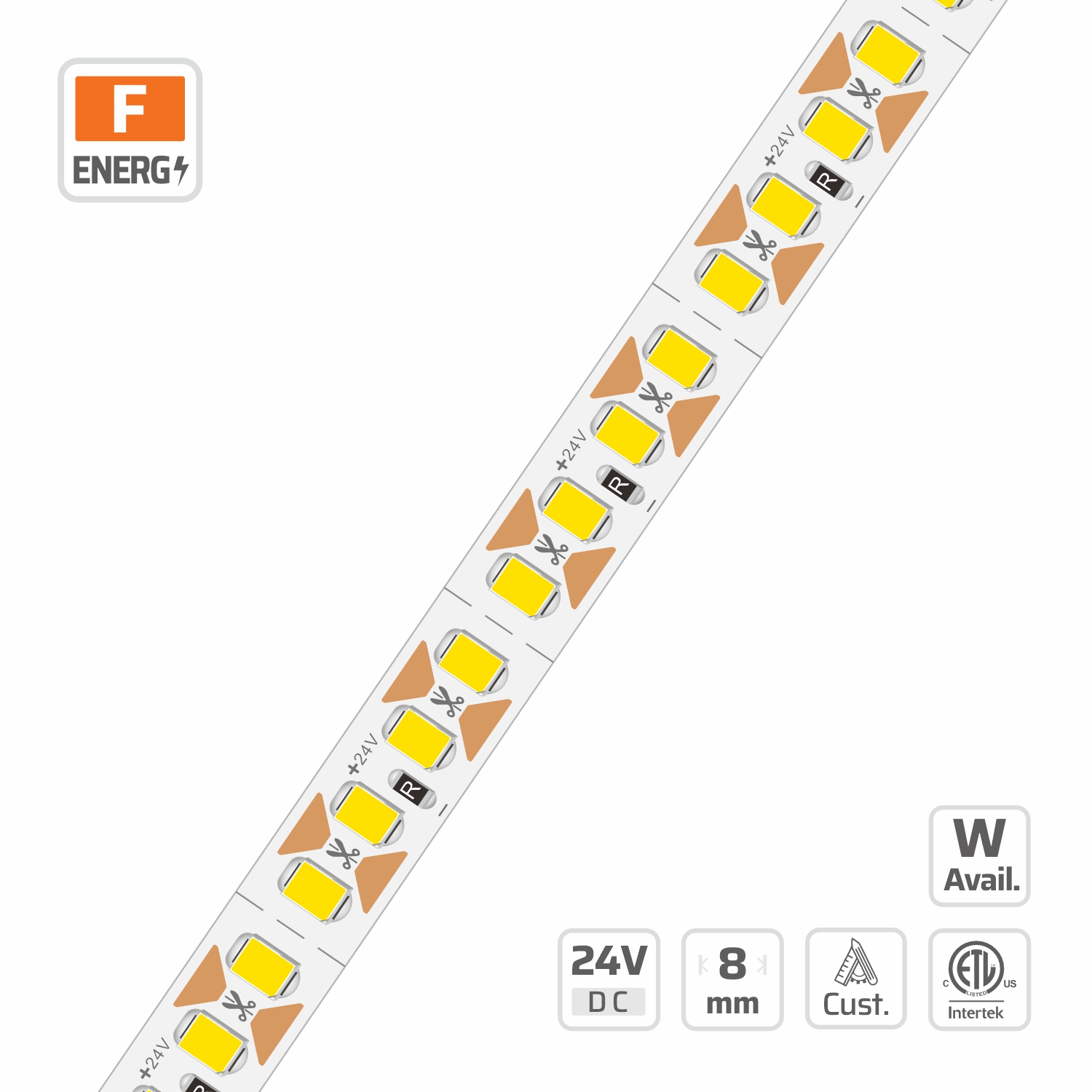
LED Type: 2835 · LED Density: 180 · CRI: Ra≥97 (Full Spectrum) · Voltage: DC24V · Power: 5.4~19.2W · Cutting Unit: Free Cut · PCB Width: 8 · Copper Foil: 3oz · Circuit Type: CV · IP Rating: IP20/IP54/IP65/IP66/IP67/IP68
Other Fita de LED SMD series
- Fitas de LED SMD 5050
- Fitas de LED SMD 3838
- Fitas de LED SMD 3030
- Fitas de LED SMD 2020
- Fitas de LED SMD 3014
- Fitas de LED SMD 2216
- Fitas de LED SMD 3535
- Fitas de LED SMD 1515
- Fitas de LED SMD 2110
- Fitas de LED SMD 6060
- Fitas de LED SMD 2835
- Fitas de LED SMD 0807
- Fitas de LED SMD 5630
- Fitas de LED SMD 1608
- Fitas de LED SMD 3528
- Fitas de LED SMD 5054
- Fitas de LED SMD de Espectro Completo com Excitação Violeta
- Fitas de LED SMD 1 SDCM
- Fitas de LED com Potência Selecionável
- Fitas de LED de Alta Eficiência
- Fitas de LED SMD DENO WAP™
- Fitas de LED SMD Especiais
- Fitas de LED SMD Rolo a Rolo
- Fitas de LED SMD com IC Integrado
- Fitas de LED SMD C.C. (Reguladas por IC)
- Fitas de LED SMD de Grau Marítimo
- Fitas de LED de Alta Densidade
- Fitas de LED SMD Ultraestreitas
- Fitas de LED SMD Largas
- Fitas de LED SMD Pixel
- Fitas de LED para Longos Trechos
- Fitas de LED com Emissão Lateral
- Fita de LED SMD Automotiva
- Fitas de LED SMD com Lentes
- Fitas de LED SMD Dim-to-Warm
- Fitas de LED SMD com Curvatura em S
- Fitas de LED SMD com Microcorte
- Fitas de LED SMD Clássicas
- Fitas de LED RGBW
- Fitas de LED SMD RGB
- Fitas de LED SMD com Temperatura de Cor (CCT) Ajustável
- Fitas de LED SMD com Temperatura de Cor (CCT) Ajustável ( 1 Circuito )
- Fitas de LED SMD 36V
- Fitas de LED SMD 48V
Blue-Excited Full Spectrum LED Strips
Blue-chip excitation with a multi-phosphor full spectrum coating — Ra 95+ colour rendering, R9 above 90 and the highest efficacy per watt of the two families, ideal for retail, residential and architectural white light.
Violet-Excited Full Spectrum LED Strips
Violet-chip excitation fills the 400-450 nm cyan gap left by blue-chip white LEDs, producing a smoother, sun-matched spectral power distribution for museums, studios, retail colour inspection and human-centric lighting. See the full Full Spectrum Violet Excitation SMD Strips series.
What is a full spectrum LED strip?
A full spectrum LED strip is a flexible board whose white LEDs reproduce a continuous, daylight-like spectral power distribution across 380–780 nm instead of the blue spike and cyan gap of ordinary white tape. DENO builds them at Ra 95+ with R9 above 90, in violet-excited and high-CRI phosphor versions, on 8 mm to 20 mm 24V boards.
- Colour rendering
- Ra 95+, R9 > 90, TM-30 Rf 93 / Rg 100
- Spectrum
- Continuous 380–780 nm, no cyan gap, low blue peak
- CCT range
- 1800K–6500K, 3-SDCM binning (1-SDCM on request)
- Boards
- 8 / 10 / 12 / 20 mm, 24V, 128–256 LEDs per metre
- Efficacy
- 80–110 lm/W depending on CCT and drive current
- Build options
- CV or constant-current, free-cut, IP20–IP68
Full spectrum LED strip models compared
Five 24V full spectrum boards, from an 8 mm dot-free micro-SMD build to a 20 mm dual-row high-output board. All are Ra 95+ with R9 above 90 and are configurable for CCT, IP class and cut unit.
| Model | SMD | PCB width | Density | LED pitch | Cut unit | Power | Circuit | Best for |
|---|---|---|---|---|---|---|---|---|
| #11153-N | 2216 | 8 mm | 256 LEDs/m | 3.9 mm | 8 LEDs / 31.25 mm | 3.8–15 W/m | Constant voltage | Dot-free full spectrum line in slim 8 mm channels and cabinet reveals |
| #20480 | 2835 | 8 mm | 180 LEDs/m | 5.6 mm | Free cut (1 LED) | 5.4–19.2 W/m | Constant voltage | Millwork and shopfitting where every segment is cut to an exact length |
| #3015-FS | 2835 | 10 mm | 128 LEDs/m | 7.8 mm | 8 LEDs / 62.5 mm | 2–23 W/m | Constant voltage | Highest efficacy per watt — large-area residential and office coves |
| #3410-F | 2835 | 12 mm | 160 LEDs/m | 6.25 mm | 8 LEDs / 50 mm | 2.4–28.8 W/m | Constant current | Long runs that must hold identical brightness and CCT end to end |
| #5871-F | 2835 | 20 mm | 256 LEDs/m | 7.8 mm (dual row) | 8 LEDs / 31.25 mm | 3.8–46 W/m | Constant voltage | Highest output full spectrum board — galleries, retail and high ceilings |
How a full spectrum LED strip differs from ordinary high CRI tape
Both a full spectrum LED strip and a standard Ra 90 board can pass the same average colour rendering figure, yet look different on skin, timber and printed colour. The difference is the shape of the spectrum, not the headline number.
Violet excitation instead of a blue pump
Conventional white LEDs excite yellow phosphor with a 450 nm blue die, which leaves a sharp blue spike and a dip around 480 nm. A violet-excited full spectrum LED uses a ~405 nm die with a multi-phosphor blend, so the 420–500 nm region fills in and the curve tracks daylight far more closely. That is what removes the clinical cast from white surfaces.
R9 and the deep red band
Ra averages only eight pastel test colours and ignores saturated red. DENO specifies R9 above 90 on every full spectrum build, which is what keeps red merchandise, timber, food and skin tones from flattening out under the fixture. Full TM-30 Rf/Rg data is supplied with the test report on request.
Melanopic content for human-centric lighting
Because the spectrum is continuous rather than spiked, melanopic ratio can be tuned by CCT selection instead of by adding a separate channel. Warm 2700K builds keep evening melanopic stimulus low, while 5000K–6500K builds support daytime alertness in offices, classrooms and care environments.
The trade-off: efficacy per watt
Filling the spectrum costs lumens. A full spectrum LED strip runs roughly 15–25% below a comparable Ra 80 board — typically 80–110 lm/W against 130–150 lm/W. Where a project needs both, DENO mixes a full spectrum run for the visible feature and a high-efficacy board for the general wash.
Where full spectrum LED strip lights are specified
Colour fidelity earns its premium wherever the observer judges a surface, a product or a face rather than the light itself. These are the four project types DENO ships full spectrum boards for most often.
Galleries, museums and art studios
Pigment shifts are visible under a spiked spectrum long before an instrument records them. Continuous-spectrum boards at 3000K–4000K, Ra 95+ and 3-SDCM keep painted and printed colour stable along a picture rail, and low UV content protects sensitive works.
Retail, jewellery and food display
Fresh produce, meat, textiles and gemstones all rely on saturated red and deep blue rendering. A high R9 full spectrum LED strip keeps merchandise looking as it does in daylight, which is why display cases are usually the first place a specifier upgrades from standard tape.
Residential and hospitality interiors
In kitchens, wardrobes and bathrooms the light falls on skin and natural materials. Warm 2700K–3000K full spectrum boards at Ra 95+ render timber grain and complexions without the greenish cast of low-cost tape, and pair with dim-to-warm control for evening scenes.
Studios, clinics and human-centric workplaces
Cameras and colour-critical tasks resolve spectral gaps the eye tolerates. Flicker-free constant-current drive plus a continuous spectrum gives clean on-camera colour, accurate tissue and material inspection, and TM-30 documentation for WELL or human-centric lighting submissions.
Specifying and ordering a full spectrum LED strip
Every full spectrum board in the table above is an OEM/ODM platform rather than a fixed SKU. These are the parameters that are configured per order.
CCT, binning and consistency
1800K to 6500K is available across the range, binned to 3 SDCM as standard and 1 SDCM on request so multiple reels installed in one room stay visually identical. Dual-CCT tunable-white full spectrum builds combine two phosphor sets on one board.
Board width, density and cut unit
8 mm, 10 mm, 12 mm and 20 mm boards cover 128 to 256 LEDs per metre, with cut units from a single LED on the free-cut build to 62.5 mm. Tighter density lowers the diffuser depth required for a dot-free line in shallow profiles.
Drive circuit and run length
Constant-voltage boards suit runs up to 5 m per feed; the constant-current build holds brightness and CCT over 10 m and beyond by regulating each segment independently, which matters when colour fidelity must not drift along a gallery wall.
Protection, coating and warranty
IP20 through IP68 including clear conformal coating that does not yellow under UV, 2 oz to 3 oz copper for thermal headroom, and a 3–5 year warranty backed by in-house spectral and ageing test data supplied with each shipment.
Full Spectrum LED Strip — Buyer Questions
What makes a full spectrum LED strip different from a normal high CRI strip?
A high CRI board raises the average of eight pastel test colours; a full spectrum LED strip reproduces a continuous 380–780 nm curve with no cyan gap and a low blue peak. DENO builds them at Ra 95+ with R9 above 90, so saturated reds, timber and skin tones render as they do in daylight rather than simply scoring well on a datasheet.
Is a violet-excited full spectrum LED better than a blue-chip white LED?
For colour fidelity, yes. A violet-excited LED pumps a multi-phosphor blend with a ~405 nm die, filling the 420–500 nm region that a 450 nm blue chip leaves as a spike and a dip. The trade-off is efficacy: expect 80–110 lm/W instead of 130–150 lm/W. Blue-pump Ra 95 remains the better choice where lumens per watt drive the energy calculation.
- Related series violet excitation full spectrum boards
- Guide efficacy and ErP class trade-offs
What CRI and R9 values do your full spectrum LED strip lights reach?
Standard production is Ra 95+ with R9 greater than 90, typically TM-30 Rf 93 and Rg around 100. Every reel ships with spectral test data, and 1-SDCM binning is available when several reels must match visually in the same room. Ra 98 selections can be produced for gallery and film work on a project basis.
- Related series 1 SDCM colour consistency binning
- Related series high efficiency LED strip lights series
Which full spectrum model should I choose for a shallow cove?
Pick density by mounting depth: with 6–12 mm between board and diffuser the 8 mm 256 LEDs/m 2216 build at 3.9 mm pitch stays dot-free, while the 10 mm 128 LEDs/m board is the efficient choice behind deeper profiles. For runs that must not drift in brightness, the 12 mm constant-current board regulates each segment independently.
- Related series high density boards for dot-free lines
- Guide size diffuser depth and feed points
Are full spectrum LED strips available in 24V and are they dimmable?
All five DENO full spectrum boards are 24V, which keeps current low enough for 5 m single-feed runs and 10 m with dual feed. They dim on PWM, 0–10V, DALI and TRIAC drivers down to 1% without colour shift, because the phosphor blend is fixed rather than mixed from separate colour channels.
- Related series constant current boards for even long runs
- Guide plan feeds and driver capacity
Can full spectrum LED strip lights be used for plants or human-centric lighting?
Yes for both, within limits. The continuous spectrum supports supplementary horticulture and human-centric schemes where a magenta grow bar would be unacceptable, and melanopic content is tuned by CCT rather than by adding a channel. For dedicated high-PPFD growing, a purpose-built horticultural board is still the more efficient option.
- Related series tunable white LED strip series
- Related series dim to warm LED strip behaviour
Can I order a custom full spectrum LED strip — width, CCT or IP class?
Board width from 8 mm to 20 mm, 1800K–6500K including dual-CCT tunable white, 2 oz or 3 oz copper, free-cut segmentation and IP20 to IP68 protection are all configurable on the existing full spectrum stack-ups, so a non-standard build is a production setup rather than new tooling. MOQ and lead time are quoted per specification.
What wavelength range does the spectrum actually cover, and is the cyan gap really filled?
Emission runs continuously from 380 nm to 780 nm. On a violet-pump board the 405 nm die feeds a three-phosphor blend, so the 480–500 nm cyan region sits within roughly 15% of the neighbouring bands instead of collapsing into the dip a 450 nm blue chip leaves. Measured SPD files (5 nm resolution), TM-30 Rf/Rg and the duv figure ship with each production lot, so the curve can be verified rather than assumed.
Which colour temperatures are available, and can the CCT be tuned after installation?
Fixed CCT options run 1800K, 2200K, 2400K, 2700K, 3000K, 3500K, 4000K, 5000K and 6500K, all held inside a 3-SDCM ellipse and 1 SDCM on request. For adjustable schemes a dual-channel tunable board mixes two full-spectrum phosphor sets, so 2700K–6500K tuning keeps Ra 95 across the whole travel — unlike RGB-based tuning, which loses fidelity away from its calibration point.
- Related series tunable white 2700K–6500K boards
- Related series short cut units for tunable installs
Where is a continuous-spectrum board worth the efficacy penalty?
Museums and galleries (low UV, faithful pigment rendering), fashion and jewellery retail where saturated reds decide a purchase, dermatology and dental rooms, food halls, colour-grading suites and photo studios, plus high-end residential where timber and skin tones dominate. In warehouses, car parks and back-of-house corridors the 30–40% efficacy gap is not justified — a blue-pump Ra 80 board is the correct specification there.
- Related series efficacy-first alternatives for utility areas
- Guide specify a project build with DENO
How does the spectrum affect flicker, UV and blue-light exposure?
A 405 nm pump sits below the 450 nm blue-hazard peak, so the RG0 exempt-group rating is easier to hold at the same lux; UV-A leakage beyond the die is filtered by the phosphor layer and measures below 2 µW/lm, which suits archival display. Flicker is a driver property, not a spectral one: on constant-current segments DENO measures Pst LM below 1.0 and SVM below 0.4, so the same board stays camera-safe.
- Related series flicker-free constant-current segments
- Guide Pst LM and SVM flicker limits
Can a continuous-spectrum board be built waterproof or in long outdoor runs?
Yes. IP65 silicone coating, IP67 extrusion and IP68 filled builds are all available, and the phosphor blend is unaffected by the encapsulation because it sits under the LED lens. For long façade or landscape lines the 12 mm and 20 mm constant-current versions hold brightness across 10 m per feed, and 48V variants extend that further where trenching cost dominates.
- Related series waterproof LED strip constructions
- Related series 48V long-run architecture